Paul Gunder

Principal Software Engineer & Architect

Paul Gunder

I modernize the systems a business can’t afford to take offline: airline pricing, telecom mediation, healthcare fulfillment. Thirty‑plus years of building every layer of the stack means I know what’s underneath before I propose what replaces it.

Based in Monument, Colorado. Open to principal and enterprise architect roles, remote or hybrid.

Now: shipping AI products of my own. Four launched October 28

    Thirty-six years of systems, deposited in layers. Select one to read about it.
    300M
    call-detail records a day through a C++ mediation platform I co-architected at MCI WorldCom
    50×
    throughput gain, 20,000 to 1M+ transactions a day, on a Verizon/Microsoft reconciliation redesign I led
    16 years
    at Sabre, promoted through four roles to Principal II Software Architect
    Millions
    in recurring licensing eliminated by moving a CORBA platform off commercial middleware

    See how I fit your role

    Paste a job description and get a one-page brief: where my experience matches, with the employer and years behind each claim; where it doesn’t; how I’d approach the first 90 days; and what I’d ask you. Share it with your hiring team or save it as a PDF.

    Written by Claude from my résumé, with gaps stated as plainly as matches. The posting itself isn’t stored.

    Ask about my background

    Short on time? Ask a question and get an answer drawn from my résumé and this site. It runs on Claude, and I built it the same way I’d build anything for production: grounded, scoped, and honest about what it doesn’t know.

    Answers are generated, so for anything that matters, confirm with me directly.

    Try one of these

    What I bring to a team

    Modernization without the outage

    I design migrations where legacy and modern platforms run side by side, phase by phase, so the business never bets its revenue on a cutover weekend. Mainframe offload, service decomposition, and middleware replacement are my home ground.

    Architecture for real volume

    Hundreds of millions of records a day, pricing engines airlines depend on, transactional integrity under load. I design for throughput, concurrency, and resiliency first, and I measure it in production with Prometheus and Grafana.

    The person you call when it’s stuck

    For years I’ve been the escalation point for the production, performance, and messaging problems that resisted everyone else. I still read the code, the logs, and the queue depths myself.

    Products I’ve built and run

    Rocky Mountain Apps is my independent studio. I take each product from idea to production myself: architecture, code, infrastructure, billing, and support, with AI coding agents in the loop. Pick one and try a small recreation of what it does.

    5
    products live
    4
    launched Oct 28, 2026
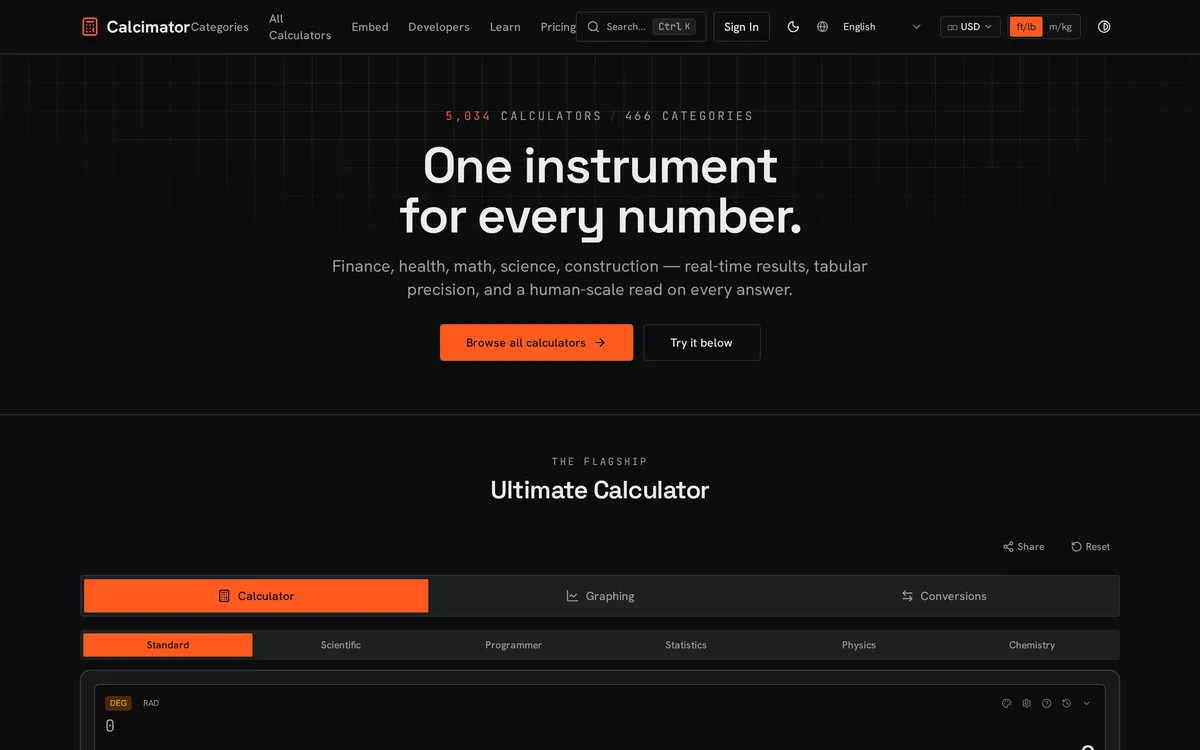
    5,034
    calculators on Calcimator
    savedjob.com
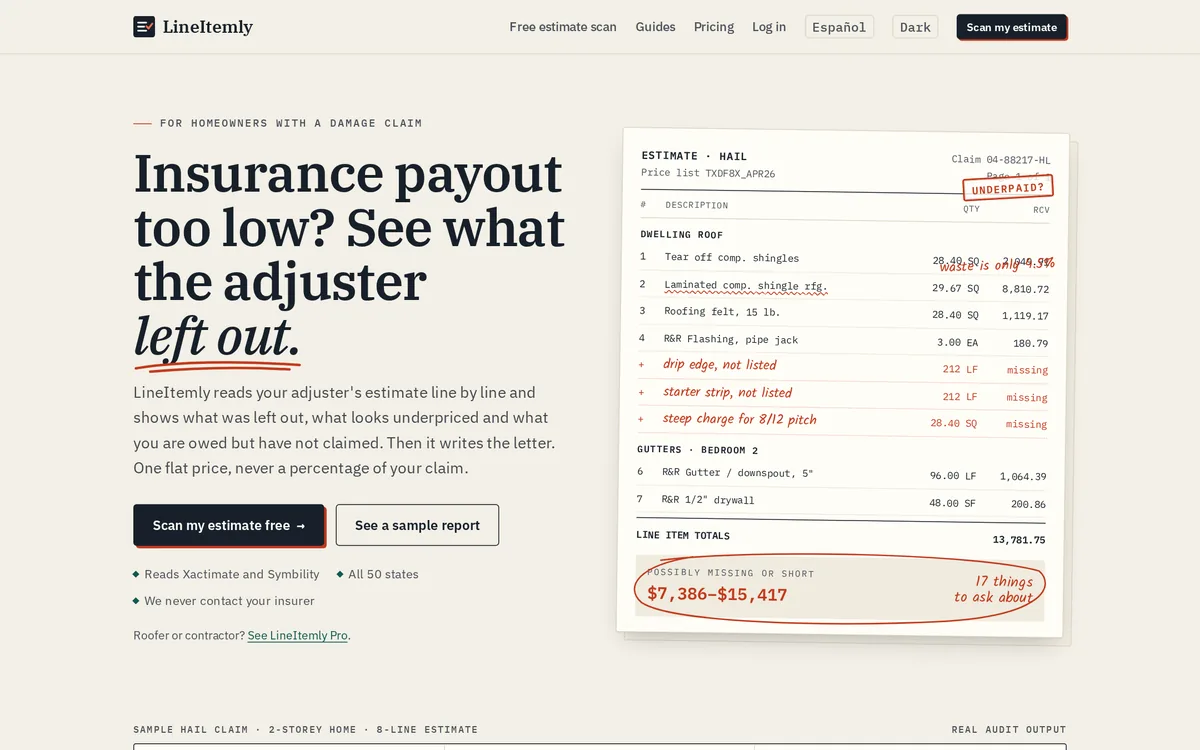
    lineitemly.com
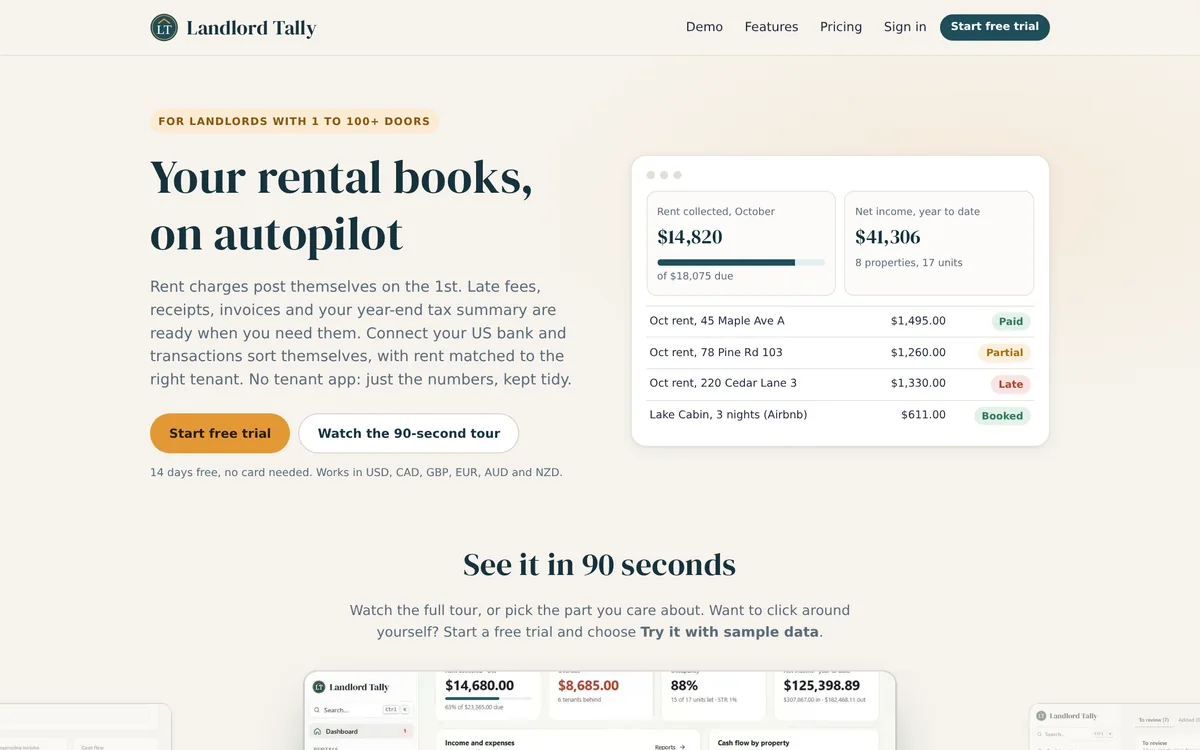
    landlordtally.com
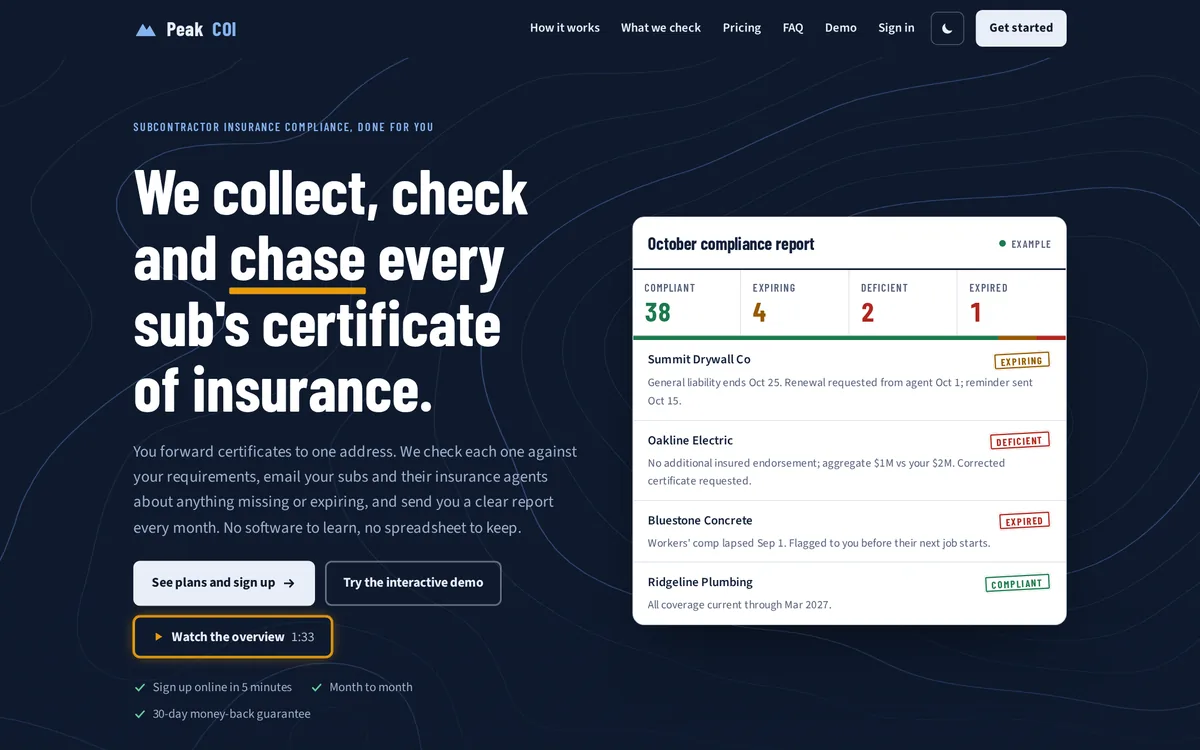
    peakcoi.com
    calcimator.com
    Rocky Mountain Apps

    Drag to turn it, or use the arrow keys. Select the front face to try that product below.

    SavedJobMissed calls become booked jobs, by text

    SavedJob

    Missed-call text-back for HVAC, plumbing, roofing, electrical, garage-door and auto shops.

    When a shop can't pick up, the caller gets a text from a local number within seconds. An AI assistant gathers the problem, address, name and time window, and the owner gets a finished work order to confirm with one reply.

    • The owner always confirms. The AI never books a job or quotes a price on its own.
    • Answers customers in their own language and summarizes for the owner in English
    • A weekly report of the jobs it saved

    How I built it

    • Node 22
    • PostgreSQL
    • Claude
    • Twilio SMS and voice
    • Stripe
    • Docker Swarm
    • Traefik
    • Cloudflare Workers

    Every outgoing text passes a single safety gate: US numbers only to block SMS-pumping fraud, per-number, per-shop and account-wide daily caps, one text per caller per day, STOP handling, and quiet hours in the shop's time zone.

    About 400 automated tests run against a throwaway Postgres schema.
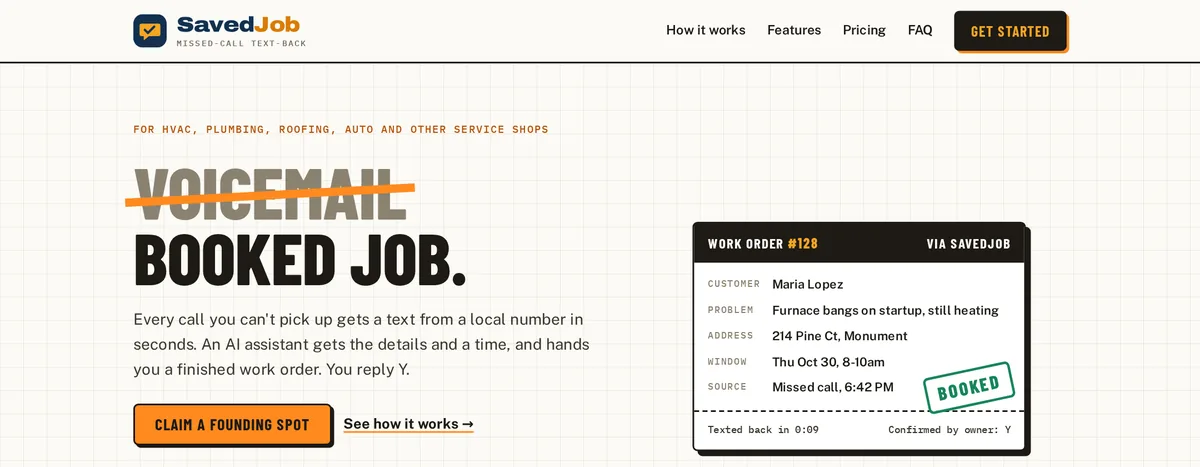
    SavedJob home page with a booked work order created from a missed call

    A missed call, start to finishSimplified recreation

    Customer’s phoneSummit Heating

    The owner is on a roof. Their text arrives here when the details are in.
    Underneath all five: Keystone

    I also built the platform they run on. Keystone is a control plane for the whole portfolio: each app registers with a small manifest, and Keystone watches its health and metrics, runs operational commands, and offers an audited database workbench. Client SDKs exist in JavaScript, Python, Go, Java, C# and C++, and a provisioning tool sets up billing and app-store accounts for a new product from one manifest.

    • Cloudflare WorkersLandlord Tally, Peak COI, marketing sites
    • Docker Swarm + TraefikSavedJob, LineItemly, Calcimator
    • ClaudeReads receipts, estimates and certificates; runs SavedJob’s conversations
    • KeystoneHealth, metrics, operations and audit across all of them

    Selected work

    Four projects that show how I approach hard systems problems. Each one started with understanding what already existed.

    Sabre, 2021–2026

    Moving airline currency and daylight-saving logic off the mainframe

    The situation

    Decades-old mainframe processing for currency conversion and daylight-saving time sat underneath Sabre’s airline pricing. Countless downstream consumers depended on its exact behavior, message formats, and data.

    What I did

    Worked with an external consulting team to define the target-state architecture: service boundaries, data flows, integration patterns, and a migration strategy that let legacy and open-systems implementations coexist safely. Designed cloud-native services on GCP and GKE integrated through Google Pub/Sub and IBM MQ, and optimized the Oracle structures that hold historical pricing and currency data.

    Why it mattered

    Revenue-critical capability moved toward maintainable, observable, cloud-ready services without putting live pricing at risk, and the patterns became reusable for Sabre’s broader Tech Modernization program.

    • Java
    • Spring Boot
    • GKE
    • Google Pub/Sub
    • IBM MQ
    • Oracle
    • Prometheus

    MCI WorldCom, 1998–2002

    A mediation platform for 300 million call records a day

    The situation

    Every call on the network produced a detail record that had to be collected, validated, and passed to billing, continuously, with no tolerance for loss.

    What I did

    As one of two primary engineers, I architected and built the core C++ platform: frameworks for network communications, asynchronous messaging, multithreading, database access, monitoring, and event processing that every component was built on.

    Why it mattered

    The platform sustained over 300 million records a day in a distributed Unix environment, and its shared frameworks cut duplication across the whole system.

    • C++
    • Unix
    • Multithreading
    • Async messaging
    • Oracle

    Verizon, 2002–2004

    From 20,000 to over a million transactions a day

    The situation

    A service-reconciliation platform shared between Microsoft and Verizon had hit its ceiling at roughly 20,000 transactions a day.

    What I did

    Led the architecture and redesign as project lead, covering application processing, data management, integration, and operations, and directed the team through implementation.

    Why it mattered

    Capacity rose fifty-fold to more than a million transactions a day, and the new platform passed external process and security audits on the way to production.

    Verizon Business, 2005–2010

    Retiring commercial CORBA middleware without breaking anything

    The situation

    A major distributed telecom platform ran on Orbix, a commercial CORBA ORB carrying heavy recurring license and support costs, plus proprietary Rogue Wave dependencies.

    What I did

    Architected and executed the migration to open-source ACE/TAO, preserving interface and integration behavior across the system. Replaced the Rogue Wave dependencies and moved legacy messaging to standards-based web services.

    Why it mattered

    Millions of dollars in recurring licensing went away, vendor lock-in dropped, and critical telecom services kept running throughout.

    • C++
    • CORBA
    • ACE/TAO
    • Web services
    • Oracle

    Run a mainframe offload yourself

    A simplified model of how I move a capability off the mainframe while the old system keeps answering customers. Step through it, drag the traffic dial, and try skipping a step to see what happens.

    Pricing requests
    Traffic router
    MainframeCurrency and DST
    Cloud servicesGKE and Pub/Sub
    Customers
    Comparator
      Requests
      0
      Answered by mainframe
      0
      Answered by cloud
      0
      Differences caught privately
      0
      Wrong answers customers saw
      0

        Illustrative and simplified: the edge cases shown are typical of currency and time-zone systems, not records from a specific project.

        How I work

        Learn the system before redrawing it. Long-lived platforms carry decades of decisions in their message formats, data models, and downstream consumers. I map that behavior first, because the riskiest part of a modernization is the dependency nobody wrote down.

        Let old and new coexist. I favor multi-phase migrations with clear interface contracts, where each step is reversible and production stays stable. Ambition is fine; a big-bang cutover usually isn’t.

        Choose the pragmatic option. Every architecture is a set of tradeoffs between performance, consistency, operational complexity, team skills, and migration risk. I make those tradeoffs explicit so teams can decide with eyes open.

        Stay hands-on. I review designs and code, write proofs of concept, and sit in on production incidents. Architects who can’t debug the system lose the team’s trust, and they deserve to.

        Raise the people around me. I led a team at Sabre for a decade. Mentoring, engineering standards, and clear design reviews are how good architecture outlives any one person.

        AI in my engineering practice

        I use AI tools every day, in my architecture work and in the products I build on my own. Here’s where they help and where I keep a human firmly in charge.

        Mapping unfamiliar systems

        Claude and NotebookLM give me a fast first pass over large legacy codebases and design documents. I treat the result as a set of hypotheses to check against code and production behavior.

        Stress-testing designs

        Before committing to an architecture, I have a model argue each option, list failure modes, and probe edge cases. It’s a tireless sparring partner, but it doesn’t make the call.

        Prototypes in hours

        With AI coding agents in the loop, a proof of concept that used to take days runs in an afternoon, so more ideas get tested against reality instead of debated.

        Guardrails, not autopilot

        Data integrity, money, and availability decisions stay with people who carry the pager. The most important skill now is telling a correct answer from a fluent one.

        I don’t just use AI tools; I ship products built on them. Claude reads receipts in Landlord Tally, estimates in LineItemly and insurance certificates in Peak COI, and runs SavedJob’s customer conversations, each behind schemas, spend caps and human approval where it matters. See the products.

        This site is a working example too. The role-fit brief and the assistant are Claude-powered endpoints on Cloudflare, grounded only in my résumé, with structured output, streaming, and prompt caching to keep them fast and inexpensive.

        It’s also built for the AI tools recruiters now use. There’s a profile for AI assistants, a machine-readable résumé, and an MCP server, so you can connect Claude or another assistant directly and ask it about me:

        claude mcp add --transport http paul-gunder https://paulgunder.com/mcp

        Experience

        1. 2010–2026

          Sabre Corporation Southlake, Texas and remote

          1. Principal II Software ArchitectJul 2024 – Jul 2026
          2. Principal Software EngineerApr 2021 – Jun 2024
          3. Team LeadAug 2011 – Apr 2021
          4. Senior Software DeveloperApr 2010 – Aug 2011

          Promoted through four roles over sixteen years, ending as a senior technical architect responsible for enterprise modernization, solution architecture, and the evolution of revenue-critical airline technology platforms.

          Read the details
          • Provided architecture leadership for Sabre Tech Modernization, moving long-standing mainframe capabilities to distributed, cloud-ready architectures while staying compatible with complex existing systems and workflows.
          • Led architecture for the Currency and Daylight-Saving Time mainframe offload, defining target-state architecture, service boundaries, data flows, integration patterns, and migration strategy with an external consulting team.
          • Designed and evolved high-volume systems for airline pricing where availability, transactional integrity, and predictable performance were critical.
          • Defined service decomposition and integration strategies for tightly coupled, long-lived applications, introducing reusable patterns, interface contracts, and engineering standards.
          • Designed cloud-native services on Docker, Kubernetes, GCP, and GKE, including deployment architecture, configuration, security, scaling, and monitoring.
          • Architected event-driven integrations with IBM MQ, JMS, Google Pub/Sub, and proprietary messaging frameworks across distributed and legacy platforms.
          • Designed and optimized Oracle architectures, SQL/PLSQL processing, and historical datasets for pricing and currency processing.
          • Established production observability with Prometheus, Grafana, centralized logging, health indicators, and alerting.
          • Modernized delivery with Maven, Jenkins, GitHub Actions, Ansible, automated testing, and container-based CI/CD.
          • Served as senior escalation point for architecture, production, performance, concurrency, messaging, database, and infrastructure issues.
          • Adopted AI engineering tooling, including GitHub Copilot, Claude, Gemini, and NotebookLM, in day-to-day architecture and development work.
        2. 2005–2010

          Verizon Business Richardson, Texas

          Senior Software Engineer / Technology Consultant

          Senior engineering and architecture leadership for business-critical telecom platforms: modernizing legacy technology, reducing proprietary dependencies, and improving deployment and operational support.

          Read the details
          • Architected and executed the migration of a major CORBA platform from Orbix to open-source ACE/TAO, eliminating millions in recurring licensing and support costs.
          • Removed proprietary Rogue Wave dependencies and modernized legacy messaging with standards-based web services.
          • Built reusable development, deployment, installation, and environment-management tooling that standardized dev, test, and production.
          • Worked across C++, Java, Unix, Oracle, C#, ASP.NET, CORBA, and web services, spanning application, middleware, database, and infrastructure.
        3. 2004–2005

          Caremark Richardson, Texas

          Senior Software Engineer, Consultant

          Enhanced a HIPAA-compliant specialty prescription fulfillment platform, building reusable C++ frameworks, automated regression testing, and production-support capabilities on SunOS and DB2.

        4. 2002–2004

          Verizon Irving, Texas

          Senior Developer / Project Lead, Consultant

          Led the architecture and redesign of a Microsoft/Verizon service-reconciliation platform, raising capacity from about 20,000 to more than 1 million transactions a day and delivering it through external process and security audits.

        5. 1998–2002

          MCI WorldCom Richardson, Texas

          Senior Software Engineer, Consultant

          One of two primary engineers behind a C++ telecom mediation platform processing more than 300 million call-detail records a day, including its frameworks for networking, messaging, threading, data access, and monitoring.

        6. 1998

          GTE / Verizon Grapevine, Texas

          Senior Software Engineer, Consultant

          Built C/C++ and Oracle ETL applications for a telecom product catalog, roughly doubling processing efficiency and automating data-quality correction that had been manual.

        7. 1995–1998

          Gateway Technologies Carrollton, Texas

          Senior Software Engineer

          Designed telecom systems for customer service, billing, validation, call-detail processing, and reporting. Migrated legacy databases to Sybase SQL Anywhere, cutting daily processing time by about half.

        8. 1990–1995

          Amigos Bibliographic Council Dallas, Texas

          Technical Support Specialist / Project Team Lead

          Led large-scale library data conversion and automation projects. Wrote a C++ automation utility that saved about $120,000 a year by replacing manual processing.

        Toolkit

        Technologies I’ve used in production, grouped by where they sit in a system.

        Architecture

        Enterprise and solution architecture, legacy-to-modern transformation, mainframe offload, service decomposition, event-driven design, target-state and migration strategy, high availability, performance engineering

        Languages

        Java, Spring Boot, C++, C, SQL, PL/SQL, Python, JavaScript, C#

        Cloud and platform

        Google Cloud Platform, GKE, Kubernetes, Docker, Linux

        Messaging and integration

        IBM MQ, JMS, Google Pub/Sub, REST, SOAP, CORBA, ACE/TAO

        Data

        Oracle, PostgreSQL, MariaDB, MySQL, SQL Server, DB2, high-volume transactional modeling and tuning

        Delivery and observability

        GitHub Actions, Jenkins, Maven, Ansible, Git, Prometheus, Grafana, centralized logging and alerting

        AI-assisted engineering

        Claude, GitHub Copilot, Gemini, NotebookLM, used daily for design exploration, code review, and documentation

        Domains

        Airline pricing and travel, telecom mediation and billing, healthcare fulfillment, library data systems

        Let’s talk about your platform.

        If you’re planning a modernization, scaling a system that’s outgrowing itself, or need an architect who will also read the stack trace, I’d like to hear about it.

        Monument, Colorado, on Mountain Time. Available for remote work across US time zones.